I was today years-old when I discovered the jackdaw was protagonist of so many fables. (Well, today and a few weeks, but who’s counting?) It came to my attention after I started work on a version of ‘The Jackdaw and the Fox’ and my research turned up five or six other stories I’d previously not noticed. These I will consider below, but first a few words by way of introduction to the bird.
The Jackdaw is a small corvid distinguished by its grey nape and its pale grey eyes. An intelligent bird, inquisitive, omnivorous and opportunist, but social. It’s noisy, discordant call – ‘the swans will sing when the jackdaws are silent’ said the Greeks – may be the reason it gets such harsh treatment in the world of fable. In the fables I have discovered (see below), it winds up either dead, captive, ostracized, or humiliated.
A Wanting Creature
Jackdaw is what I would call a ‘wanting creature,’ ruled by appetite and envy, discontented, dissatisfied, but determined to improve its lot. A comic character, because these are typical motives in comedy and Jackdaw rarely harms anyone (but itself) by its efforts. And as when it tries to change its identity or improve its position in society, it falls victim to satire, the ugly side of conservatism which tells us to know our place/get back in our box.
the Fables
‘A Daw with a String At’s Foot’ – a Jackdaw kept as a child’s pet escapes, but dies when the string gets caught on the branch of a tree. The moral varies. L’Estrange sees it as an example of how it is better to be content to what you have, in this case easy servitude among men, while Gibbs’s translation suggests the story is appropriate for those who find greater difficulties after extricating themselves from moderate ones.
‘The Jackdaw and the Pigeons’ – envying the easy, well-fed life of pigeons, the Jackdaw decides to disguise itself as one of them, but its deception is exposed when it opens its mouth to express its satisfaction, returning to its own kind it finds itself rejected. This is another warning to be content with what you have, leave it behind and it may not be there for you when you return.

‘The Jackdaw in Borrowed Feathers’ – there are a number of version of this fable and it is the origin of phrase, to go about in borrowed feathers. In the nicest version, Jackdaw confesses it considers itself ugly and the eagle advises improving itself by wearing borrowed feathers. It works too well and the Jackdaw becomes boastful, provoking the other birds to pluck his borrowed feathers and leave him naked and humilated.
‘The Jackdaw and the Eagle’ – Jackdaw sees an eagle carrying off a lamb, when it tries to do the same its claws get caught in the wool. It is either killed by the shepherd or, as in L’Estrange and Townsend, captured and clipped and made into the child’s plaything we see in the first story. Another on the ‘know thy place’, but here there is obvious wisdom in understanding one’s limitations.
‘The Jackdaw and the Ravens’ – a Jackdaw happens to be bigger than its peers and decides to go and join the ravens, but the ravens do not accept him and when he returns to his peers they reject him too.
An Unresolved Action
The most intriguing of all these fables is ‘The Jackdaw and the Fox,’ also known as ‘The Jackdaw and the Figs’ [Gibbs, Aesop’s Fables, OUP]
A hungry jackdaw alighted on a fig tree. He discovered that the figs were still not ripe, so he decided to wait until they were ready. A fox saw the jackdaw loitering there and asked him what he was waiting for. The fox then offered the jackdaw this piece of advice: ‘It is a big mistake to entertain such expectations: hope will lead you on at first but then leave you empty-handed.’
Curiously, the fable ends before the action is resolved. The fox offers its advice but the evidence is literally inconclusive: the figs might ripen and the Jackdaw may yet enjoy them. My guess is that the ‘wisdom’ here is feed when you can. Do not forego opportunities in the hope of enjoying an especially tasty morsel in the future. A bird in the hand. Fair enough, but I want to see how this scenario plays out. Carlo Gebler felt the same way and in his amusing, sardonic version the Jackdaw wastes away and dies.
I have to admit I identify with Jackdaw in this scenario. Who wouldn’t fancy a sticky sweet fig picked straight from the tree? When I pass some fruit growing wild, I make a plan to return. But Jackdaw’s error is to remain there and wait. Why does it make this error? Previous fabulists, including Gebler, seem to attribute it to hunger. They describe the Jackdaw as half-famished. But this doesn’t work for me. If it were half-famished, its appetite would not be so selective.
the Pleasure Motive
This must surely be a matter of pleasure-seeking, of reason overcome by desire, overwhelming desire.
Either way, what is surprising is the lack of action in the narrative. The Jackdaw sees something, wants it, and sits and waits for it to be ready. It exhibits patience, which on most occasions is a virtue. You’d think this approach would deserve reward, but that would not make much of a story. There would be no conflict or contradiction. There is no drama, no hook, in a story where postive action leads directly to a positve outcome.
But questions remain: why does Jackdaw not realise the figs will take too long to ripen? why does it not give up the vigil when hunger and thirst become too much? why does it refuse to risk losing the figs?
I have an answer.
the Fear of Missing Out
It’s odd for the character of the fox to be introduced and used as narrator or observer rather than as an actor in the drama. This seems a missed opportunity. Like the Jackdaw, the fox is a covetous creature, as well as cunning, and mischievous. The Jackdaw would see it as a rival, and its advice against waiting will be understood as a trick, evidence the Fox also intends to consume the figs. It is this threat which keeps the Jackdaw from leaving to eat or drink.
The moral does not change, but the action develops as a rivalry between Fox and Jackdaw.
Read: ‘The Jackdaw and the Fox‘



 ‘
‘
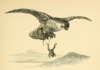


 The Townsend version hints at the romance of the tying-together. This symbolism is central to the text of the great Persian poet Rumi. The roles are reversed in Rumi’s account. His is a love story, and an allegory of body and soul, in which the mouse, frustrated it cannot be with the frog whenever it wishes, petitions its lover to allow themselves to be attached by a piece of string. Thus they may summon each other when the need arises. The frog consents, but the mouse is seized by a bird of prey and the frog is pulled from the pond—where it was immersed in eternal bliss—to its death. It should have resisted attachment, Rumi argues.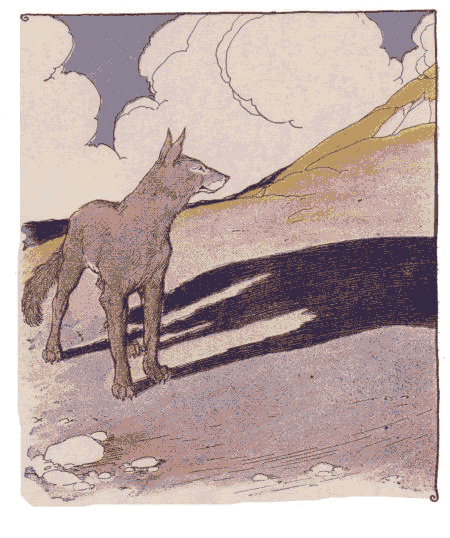
 Our shadows are incomplete, imperfect imitations of ourselves. When the sun is high, they cower unformed at our feet, while later, they walk by our side, like children, devoted and playful, and small. But as the sun goes down, the shadows start to outgrow us; they stretch, as far as they dare, before turning back and waving, forgetting they are still attached. And should we pass a wall, a fence, or a rock face, they rise up and tower above us, roles reversed, and we find ourselves the inferior party. Overshadowed, literally.
 The fable wastes no time getting to the point. In all extant versions, the wolf gets attacked the instant he concludes that his mighty shadow proves his pre-eminence among animals, as if the thought itself invites the attack. This strikes me as premature and abrupt. Unnecessarily so. Let the wolf enjoy his reveries as the sun goes down. It’s quite harmless to imagine oneself stronger than you really are. However, if the wolf were to act upon its delusions, that would be the point at which fantasy met reality, pride took a fall, and lessons would be learned.
 Many Aesopic fables are little more than a description of a situation or an action; to call them stories would be to stretch the definition. The situation does not develop, there is no turning point, sometimes there’s no conflict at all. A character makes an observation, a comment aimed at another and this all that is required to articulate the lesson. I love fable, but these are the fables I tend to pass over.