Aphorisms #1
~~~
“the mosquito don’t buzz when it’s drinking your blood”
~~~

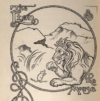
[illustration: Hans Hoffman, 1530-1592]
~~~
“the mosquito don’t buzz when it’s drinking your blood”
~~~

[illustration: Hans Hoffman, 1530-1592]
![]()
A great many fables consist of nothing more than a brief dialogue. As a rule, these fables pass me by. They’re too obviously didactic, too dry, the juice squeezed out of them, the flesh stripped.
The dialogue typically takes the form of answer to a question or challenge, an answer which articulates the moral. And that’s it. There is no story, no turn of events, no surprise. The only colour comes from the quality of the observation, the insight revealed in the line of comparison drawn between human behaviour and that of the natural world.
One of the better examples is Robert Dodsley’s ’The Kingfisher and the Sparrow’ [read here], in which a sparrow, a town-dweller, exhorts a kingfisher to display its beauty to the world. Dodsley draws on observable charasteristics of the two birds. Kingfisher plummage is vivid and brilliant and yet it is an elusive sight, confined to its habitat of rivers, canals, and wetlands. You won’t see it flying overhead or hopping about the hedgerows.
The sparrow argues the kingfisher was given those attributes for the visual pleasure of others and should not therefore hide itself away. It ought to exploit them for fame and adulation. ‘No!’ says the Kingfisher. ‘Not interested. I have no need for any of that fuss.’
“I have learned not to build my happiness upon the opinion of others, so much as on my own conviction, and the approbation of my own heart.”
I applaud the message, an affirmation of being true to yourself, but it remains only that, a message. A message sealed with a simile. Take it or leave it.

‘The Young Lady and the Looking-Glass‘ by William Wilkie claims to be a metaphor for how fables work. A mother puts a mirror in the corner where her spoiled and willful daughter goes to sulk and thus, by seeing her reflection in these moments, they young lady is confronted by the deformity her behaviour inflicts upon her appearance, and this is enough to get her to change her ways.
The mirror is fable:
“It is a mirror, where we spy
At large our own deformity
And learn of course those faults to mend
Which but to mention would offend.”
Wilkie argues that calling someone on their faults directly doesn’t work: “To bid your friend his errors mend, is almost certain to offend.” They will resist. (Call out culture on social media tends to confirm that observation.) Fable provides an indirect means to make the point instead. But will the subject recognize themselves in the fable?
It can’t offer a direct reflection, nor even a corresponding one. The characters in fables are not typically human, but animals or inanimate objects, and if they are human, they are persons as remote as kings and beggars. How then will this recognition take place?
This reminds me of the problem of satire, and many of these English fables (collected by Cooper) hail from the age of satire. Satire hopes to shame the intended target by means of exaggeration, caricature, reductio ad absurdum. It often fails because the target rarely sees themselves as such. If a bully sees themselves as a victim, they will identify with the victim not the oppressor. If they believe their behaviour justified, it will be someone else who needs reproof, not them, someone less reasonable.
Less a mirror than an unwashed window.
Sure, fables may be inspired by things that happen in the real world, but this response is one of generalization and exemplification. A fable removes the insight from the real life instance and distills it into a tangible narrative form, to which we can assent—this is the way of the world, this is foolish, this is wrong—or dissent, by offering a counter-example.
This is the role it can be seen to play in the Panchatantra. In the framing story, each chapter sees the prince inviting a wise man to illustrate a value or insight. The wise man does this by telling a story and within those stories characters tell other stories, using them as arguments and counter-arguments to advance, change or defend a course of action.
The difference between condemnation and discussion, between morality and ethics.

Fruit falls from trees when ripe, if we don’t pick it, or if birds and insects and rodents don’t get to it first. Thinking about the Garden of Eden, I wondered what if the fruit from the Tree of Knowledge of Good and Evil also fell? What if Eve found it on the ground and understood this as permission to eat? What if this were the temptation?
The idea of things going to waste, especially something as precious as knowledge, is intolerable. If this were the choice confronting Eve, I would not blame her for breaking the taboo. In fact, I would applaud.
Prompted by this slightly whimsical supposition, I wrote a new version of the pivotal scene Read it here before moving on to the commentary:
~~~
Paintings of the Garden of Eden tend to depict it as an orchard, or a landscape of woods and meadows, but always trees bearing fruit. The text emphasises the trees. “Of every tree of the garden thou mayest freely eat,” God declared. “But of the tree of the knowledge of good and evil, thou shalt not eat of it: for in the day that thou eatest thereof thou shalt surely die.”
[Reader, they did not die.]
Combine the trees and the fruit with the nakedness of Adam and Eve and you have a childlike portrait of innocence. An image which the eating of the forbidden fruit destroys, primarily by making them ashamed of their nakedness. (Not the kind of insight I would have hoped to gain from the Tree of Knowledge.)
A naked couple eating from abundant fruit trees denotes a life of easy gratification, an existence delivered from want and work, an eternal summer. This may be the popular understanding of Adam and Eve in the Garden of Eden. But we forget that in the previous chapter man is created, it seems, because something was missing from the agrarian landscape God had fashioned: “and there was not a man to till the ground.”
Adam was created to take that role in the picture and God invited (instructed) him to cultivate and keep the land. I suppose we are meant to assume he planted, harvested and ate his crops, or used them as feed for the beasts of the field, which he ate or didn’t eat, we don’t know. None of that is stated.
But we do know he was doing all this naked and that seems odd, and somewhat hazardous. I’m tempted to explain the disjunction as a result of story revisions and development over a many centuries from its (likely) Sumerian origins. Either that, or as an expression of scorn for the nudity of early tribes.
The real puzzle of the narrative comes later when they are expelled from Eden “lest he put forth his hand and take also of the tree of life, and eat, and live for ever.” The Tree of Life? Excuse me. Why wasn’t it mentioned before? Will they not already have eaten from it as it wasn’t subject to any prohibition? Is God just gaslighting them here, piling on the agony by exaggerating what they have lost? Or were they really going to live for ever?
The text does not seem to envisage pregnancy and children until after the expulsion from Eden so that suggests to me that Adam and Eve would have ploughed on for ever and that they must have been eating regularly if inadvertently from the Tree of Life.
“The Fables, then, must have grown up through many centuries in the country of their origin before setting out on their travels.”
Continuing with my journey through Cooper’s ‘Argosy of Fables‘, I discover that some of the Persian tales are in fact Indian in origin and that I have encountered them before. I have passed them on the road, heading in the opposite direction. I confess I didn’t recognize them immediately. Just a vague sense of deja lu, an inkling, as if time had folded over and formed a loop.
Cooper’s source was a Persian collection titled ‘Anvar-i Suhaili,’ which became (in English) ‘The Lights of Canopus.’ This collection in turn derived from a book called ‘Kalilah and Dimnah,’ which was the arabic version of the Panchatantra, aka ‘The Fables of Bidpai.’ (You can read about it here.)
The tale that prompted this bit of research was ‘The Camel Driver and the Snake’.
A camel driver rescues a snake from a bushfire, but the snake shows no gratitude. It declares it will kill both man and mount for several reasons, first, because it is in its nature, and second, because evil is the recompense mankind make for good. It proves the latter point through the testimony of an old buffalo abandoned by its masters and a tree abused by the passers-by it has sheltered. Then a fox approaches and offers its thoughts. It first wants to know how the snake managed to curl up inside the bag used in its rescue. The snake demonstrates and the fox invites the man to do what he should have done in the first place: beat the trapped snake to death.
A brutal, realist morality tale. Immutable nature, and the folly of trusting those who you know to be evil and hoping they might change. But it occurred to me that the claim the snake is evil by nature is a mistake, a mistake both parties have made.
Humankind will rightly be wary of these deadly creatures. Stories of unfortunate deaths will have been passed down since the beginning of language. In our imaginations, snakes have been cast as malign, hostile, a threat. But the fatal attacks are mitigated by self-defence, prompted by their fear of us. We are not their usual prey; there need not be evil intentions.
The snake in the story seems to have adopted the role given it by man. It has coiled its identity around hostility. It sees itself as an incarnation of evil. A killer. What if we were to confront this identification? What if we could dissolve it with calm, insightful kindness? What if that could be the message?
This is what I did. You can read my version here: ‘The Camel Driver and the Snake‘
I put to one side the snake’s argument about man’s ingratitude. The argument is a good one and the story proves as much. Its brutal conclusion represents less a prudent attitude to ‘evil’ than an obliterative reaction to an truthful accusation.

I have now reached the dusty, sun-baked expanse of Persia. The tales—of camels, rats, and stray dogs—are pithy and incisive with a wisdom that is difficult to dispute, if a little cynical. I was nodding along, with a wry smile, until I came to the tale of ‘The Red Wasp and the Honey Bee’.
Like many editions of Aesop, the Persian fables conclude with a statement the moral of the tale, an epimythium. In the case of ‘The Red Wasp and the Honey Bee.’ The moral was not what I’d been expecting. It was the opposite. In fact, it was, as I exclaimed at the time, insane.
It’s a short tale, a dialogue. A wasp attacks a honey bee “eager to feast upon her sweetness.” To discourage it, the bee points to the flowers and sweet nectar all around them, but the wasp is not impressed as he considers the bee the source of sweetness, “its fountainhead.”
Surely, the wasp is making a categorical mistake here. The bee may participate in the production of honey, but it is not itself sweet. And yet the moral of the tale endorses the wasps attack.
“Happy is the man who knows true from false, and refuses to accept less.”
Huh? I mean, yes, very good, but this isn’t the place—the action here points to a very different observation. The moral was the wrong way around and it needed redress.
Now some of you may be aware that wasps tell each other stories and that most prominent in their folklore is a character called ‘the Angry Wasp,’ a kind of anti-hero, a trickster and taboo-breaker, by turns hapless idiot or selfish-git. (An example is available to purchase here.) The Persian tale of a ‘Red Wasp’ seemed as if it could have been derived from that same folklore, the Angry Wasp story turning up in the land of fables.
This is how I think it should have been rendered: ‘The Angry Wasp and the Honey Bee.’
The latest fable was inspired by an illustration of two, well three, tortoises attributed to Hokusai. This is how I saw it:
Two tortoises come face to face. They may have been about to pass each other, but in the instant Hokusai has captured, they seem to have paused. We see the encounter from above and slightly behind. , But for one key detail, the composition is almost symmetrical: One regards the other, while the other twists its head to the side, revealing an eye that would not otherwise be visible, as if trying to catch sight of what we, from our privileged angle, can see quite plainly: a smaller tortoise perched on its back.
What is the cheeky little tortoise doing there? Did the tortoise know it had a passenger? Those are the questions, but to develop a dramatic situation, I left them unspoken, and certainly not answered, until they could no longer be resisted. And then, well… I’ll let the fable speak for itself.
You can read it here: The Tortoises.
Let me know what you think it means. (I have an answer to that.)
Maurice Sendak’s ‘Where The Wild Things Are‘ was published sixty-one years ago this week. Not a significant date it’s true—I’m one year late for the sixtieth anniversary party—but still a tweet today (from Barnes Children’s Literature Festival) commemorating the book reminded me how much I loved it and here we are, thinking about it again.
Three hundred and twenty-seven words of perfection. And twenty-nine of the most gorgeous, articulate illustrations.
For those who haven’t read it—where have you been?!—please allow me to summarise:
After putting on his wolf suit, a young boy Max overdoes the role play and gets sent to bed without his supper. A forest grows in his room and he travels across the sea to an island inhabited by fierce but endearingly dumpy monsters. He tames these ‘wild things’ and they make him their king. Then the famous wild rumpus begins. After which he sends the creatures to bed without their supper. Although they love their new kind, Max feels lonely and when he smells “good things to eat” he decides to get back into his boat and go home, where he finds his supper waiting for him in his room.
It’s tempting to headshrink this story, but I’d prefer to say it can barely contain the boy. Excess energy spills off the page, effortlessly spining themes of power, agency, imagination, aggression, friendship, play, and appetite. Ultimately, it comes down to food denied and food provided.
On reading it again, I have to ask myself if this wasn’t an influence on ‘a boy in a park.’ I certainly didn’t pick it as a reference as I was writing and yet, as a childhood favourite that I still own, I perhaps should have reached for sooner.
I don’t describe the boy in my stories (much), nor give him a name, but if I were to do so his name would be Max and I’d put him in a wolf suit—I could have some fun with that. (There’s an idea! Mmmm.) The two boys share the same solitary nature, inclined to fantasy, often frustrated, angry, seeking to assert themselves somehow, though the boy has notably less success than Max. The forest, the sea, the island, these are the parks. Like Max, the boy has his feet in the real world and his head in fantasy, but the boy’s real world is one of struggle and deprivation, tenuous and vulnerable. Max is fortunate to be able to return to a comfortable home and the love expressed in a hot meal.
What would happen to Max if his boat were scuttled and there was no way back?
Last week my cat died. He was an old boy, almost eighteen, and though he was with us only four years—he’d been brought from my elder sister’s menagerie—he had become our darling. A cat who liked to be held and who articulated himself in a range of cries and grumbles. My first and only pet. I wrote a poem for him.
~~~
little Roger is no more
he got smaller
—he couldn’t eat—
he disappeared
into my arms
now I take away
his box his bowls his blanket
remove his trays
hoover up his hair
but his voice remains
his domestic roar
little Roger is no more
~~~
Sleep well, Roger. You will be missed.
‘The Cat who Served the Lion’ (from Hitopadesha book II) is a tale of an enforcer who gets their comeuppance. A lion hires a cat to deal with a mouse who seems intent on irritating him. He rewards the cat with tasty morsels from his table, but the cat does its job too well. Confined to its hole, the mouse begins to starve and when it emerges, desperate for food, the cat kills it, and in so doing loses its job.
The fable makes a familiar point, a satirical one, alluding to the political cynicism of exploiting an issue to gain votes and then neglecting to effect a definitive solution once in power. Well, actually, I suppose the fable argues that’s what you should do: it is a mistake to solve the issue. The cat was onto a good thing and he blew it.
But you can have only limited sympathy for this character, a killer who does the dirty work of rich and powerful—in the land of fables, lions are either noble royalty or dominant brutes. It may lose its job but the mouse loses its life.
The detail of the tasty meals reminds me of the choice we are tempted to make in favour of our comfort and the suffering of others. Modern life is loaded with these wilful compartmentalizations, e.g. sweat shops and cheap branded fashion, but at its core this is the essence of ordinary corruption. Doing the dirty work of an unjust master in return for creature comforts, or as in Martin Amis’ ‘The Zone of Interest’, forging an idyllic life for your family throughe the successful administration of the Nazi gas chambers.
All this from a hindoo [sic] fable about a lion and the mouse that irritated him.
There were aspects of the fable that puzzled me, some wrinkles, peculiarities of motivation. Why, for example, did the mouse seek to irritate the lion, for example? What was its fascination with chewing the lion’s mane?—is that a known behaviour, or a fancy on the part of the author? The mouse seemed not to have imagined the terror its little games would bring upon itself.
And the climax, brief, blunt and brutal: starvation, killing, instant unemployment!
It occurred to me the message of the fable could be put into the mouth of a caught mouse begging for its life, a common device in fables. I thought ‘what if the cat made a deal with the mouse? What would that look like?’ and so I took up the proverbial pen and began to write.
And as I wrote, I thought some more.
You can read the outcome here: ‘The Lion, the Cat, and the Mice‘