Foxes, lions, sheep, frogs, jackdaws, snakes, monkeys talking to each other or to themselves. This has been the substance of a fable from the beginning, from the oral traditions of the Indian Subcontinent to the translators of Aesop and beyond.
Why? Because the distance between us (as storyteller and listener) and them allows for a narrative unburdened by our ambivalence toward our fellow men and women. In short, animals make better symbols.
But sometimes people can feature as protagonists. Notably in ‘The Boy Who Cried Wolf‘ (which I discuss here, with more than pinch of ambivalence) and also in the cautionary tales of Heinrich Hoffman, which are, arguably, fables or at least fabular.
The Elements
Fables also give voice to inanimate objects too. Aesop’s ‘The North Wind and the Sun‘, for example, sees the two elements contest each other’s abilities in a challenge to rid a man of his raincoat, presenting us with the most precise demonstration of the art of persuasion you could imagine.
Apart from talking, and having feelings, the behaviour of the wind and sun conforms to their nature as we understand it. It seems you can’t really depart from that template when using inanimate objects. You must take them as they come.
The Water Cycle
I observe this rule in my original fable about raindrops, ‘The Drops of Water‘. One of the few lessons I recall from my primary school days concerns the hydrologic cycle. It was known only as the ‘Water Cycle’ and really just explained where cloud and rain came from and where it ends up. Inspired by this elementary knowledge, I put the raindrops in the cycle and let them fall.
If raindrops could speak, I asked myself, what might they say? How might they see their destiny? What would their attitude be toward it? Would they realise how passive they are? That they take part in cycle far greater than themselves. It seemed to me that, unlike the great forces of the elements (the wind and sun), a tiny raindrop could only have a partial grasp of their nature.
This, I believe, corresponds to our own limitations, our inability to comprehend the bigger picture, and ultimately to control how things turn out, or rather to accept that we do not control it, ultimately. This is the insight that informs every beat of the narrative.
It is fanciful. Raindrops do not talk or have feelings and nor do they remain as individuals for longer than their brief journey to earth. But these raindrops aren’t really raindrops, are they?
Fables are simple narratives, often rendered in simple language, and as such easily dismissed as being ‘for children.’ Unfairly so. The Victorians may have put them to use in the nursery, but they were never intended for the younger reader.
These sometimes harsh lessons on pride and vanity, on the exercise of power, tactics and strategy, informed statecraft and political debate in the Ancient World. Socrates transposed them into verse while awaiting judgement and execution.
As an ethical system, Aesop’s fables are incoherent and contradictory, best treated as elements of folk wisdom, appealed to case by case. Each fable is an example, and thus a point of reference, of comparison or contradiction.
For me, they are a starting point. A proposition that prompts a reply. Or even another idea, another discussion.
‘The Shepherd Boy and the Wolf’
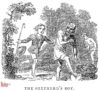
Consider Aesop’s ‘The Shepherd Boy and the Wolf’ (aka ‘The Boy Who Cried Wolf’). A simple tale of a naughty boy who gets his comeuppance. In later versions, that comeuppance is extreme: the boy loses his life; in earlier versions—the original Greek?—he loses only his sheep. In this, the villagers suffer almost as much as the boy. It is the community that sustains the economic damage. It needn’t have happened.
I have long felt the villager’s were remiss in not responding to the boy’s last cry for help. They chose to ignore him when the better course of action would have been to respond and then sack the boy for his third offence. They didn’t and are therefore partly responsible for. There is a lesson there. See my version: ‘The Shepherd Boy and the Wolf’
The moral of Aesop’s original has remained consistent across translations: there is no believing a liar, even when he speaks the truth [Townsend]. It’s curious then that the fable came to be used as a denunciation not of dishonesty, but alarmism.
‘To Cry Wolf’
I suppose the phrase was popularised by newspaper journalists and politicians censuring those making exaggerated claims of dire consequences, disaster, defeat. You risk losing your credibility, they warned.
But accusations of crying wolf can be disingenuous, a tactic to play down reasonable claims, to delay or derail calls for action that certain parties might find restrictive. It really depends on how plausible these claims are and whether it is possible to mitigate the consequences after they have transpired. (See climate change and fascism for examples of calamities which are best tackled in advance.)
This tension between sounding the alarm and claims of alarmism informs a version of ‘The Shepherd Boy and the Wolf’ that I uncovered in my research. It’s a kind of sequel; a variation or reverberation of the original, and its moral might be summarised thus: an alarm system you decline to use is also no alarm system at all.
The fable of ‘The Two Dogs’ has a simple premise: a man has two dogs, one he takes hunting, while the other remains at home on guard duty; he feeds them equal portions. This seems fair enough, but the hunting dog is not satisfied. It feels it deserves a greater share, especially when it comes to divvying up the meat from the hunt: it did the work, it argues, it should get the benefit.
A Political Fable?
So, this is a political fable examining the issues of labour and remuneration?
No. Apparently not, neither for Aesop, nor his translators. Another element is introduced into the scenario: training. The man trained the hunting dog for its task, but left the guard dog unskilled. Thus the fable sides with the hunting dog’s complaint and blames the man for the alleged inequality.
“This fable shows that the same is true of children: it is not their fault if they don’t know how to do anything, since this is how their parents have raised them.” [aesopica]
This seems … tangential.
The obvious analogy here is not pedagogy, but economics, the division of labour.
Who Gets What and Why?
There are two roles to be performed: the property must be guarded and the hunter must be assisted. Dogs are trained and indeed bred for these roles. There is good reason for them to receive equal remuneration, and that is the arrangement we find, as decided by the master, the executive.
The hunting dog wants more. You can understand its point of view. It will have been instrumental in obtaining the meat from the hunt; it likely had direct contact with it. It worked for it, while the guard dog did not. It deserves more.
However, as one of the early versions suggests, the role of hunting dog is more coveted than that of guard. The guard dog did not choose to stay at home. It would have preferred to stretch its legs by its master’s side. It would have relished the activity and the exercise. Despite its vital role, the guard dog must feel under-appreciated, even neglected. An equal portion at dinner makes up for it.
The Amplification of Privilege
Seems to me there may be more than a little self-regard in the hunting dog’s complaint, more than just the demand of a keen appetite. It knows it is privileged. It has been given more skills than its rival, it has been trained and improved. It therefore believes that superiority ought be reflected come dinnertime. And prompted by its sense of entitlement, the hunting dog takes action.
This is how I develop the action in my version of ‘The Two Dogs’.
Where the original fable sees the hunting dog’s complaint as a conclusion, a proof of an unstable, unsatisfactory situation, I use it as an inciting incident, a provocation, leading to a new resolution, one which may or may not be satisfactory. [clue, it isn’t]
This mature oak tree is not unique; its neighbours—beyond, to the side, and behind—are just as splendid, a handsome family, but from the angle I approached, and with its subtle elevation, rooted on a grassy bank, this one was the most photogenic. (I was running I didn’t stop to check all perspectives.) The thick, grey splayed trunk reminded me of an elephant’s foot. I always get the urge to wrap my arms around trees of this stature, not so much to hug them as to measure the width, to feel how far it exceeds my grasp. A tactical sense of awe.
‘The Nightingale and the Bat‘ (aka ‘The Bat and the Songbird’) is another one of those fables that struck me as mean-spirited. Here is the version translated by Laura Gibbs:
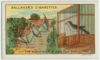
A songbird was hanging in a cage in a window. A bat flew up and asked the songbird why she sang at night but was silent during the day. The songbird said that she had her reasons: it was while she had been singing once during the day that she had been captured. This had taught her a lesson, and she had vowed that she would sing only at night. The bat remarked, ‘But there is no need for that now, when it won’t do you any good: you should have been on your guard before you were captured!’ Aesop’s Fables. A new translation by Laura Gibbs. (Oxford University Press)
You can’t argue with the moral. It is useless to repent after disaster has struck. Precautions should be taken before not afterwards. It’s sensible and pragmatic advice. But there’s a hint of victim-blaming in the scenario.
Who is to blame when a songbird is hunted and captured? The hunter or the songbird? These are rhetorical questions because, although the songbird might have taken precautions, curbed her natural behaviour, it can only be the hunter who is deserving of censure. (Less so if the predator had been an animal.)
The nightingale’s reasoning is flawed, yes, but this points to emotional disturbance not stupidity. It seems more likely that she would cease to sing during the day because she still feels the pain of her capture. She is traumatised. That she sings at all is remarkable, perhaps it is the only thing that keeps her spirit alive.
The bat misses the point. His reply is devoid of empathy. He chides the nightingale for having been captured. These are unwelcome comments, uninvited. And redundant, unless carrying an implicit demand to resume singing during the day, in which case they are presumptuous.
I was today years-old when I discovered the jackdaw was protagonist of so many fables. (Well, today and a few weeks, but who’s counting?) It came to my attention after I started work on a version of ‘The Jackdaw and the Fox’ and my research turned up five or six other stories I’d previously not noticed. These I will consider below, but first a few words by way of introduction to the bird.
The Jackdaw is a small corvid distinguished by its grey nape and its pale grey eyes. An intelligent bird, inquisitive, omnivorous and opportunist, but social. It’s noisy, discordant call – ‘the swans will sing when the jackdaws are silent’ said the Greeks – may be the reason it gets such harsh treatment in the world of fable. In the fables I have discovered (see below), it winds up either dead, captive, ostracized, or humiliated.
A Wanting Creature
Jackdaw is what I would call a ‘wanting creature,’ ruled by appetite and envy, discontented, dissatisfied, but determined to improve its lot. A comic character, because these are typical motives in comedy and Jackdaw rarely harms anyone (but itself) by its efforts. And as when it tries to change its identity or improve its position in society, it falls victim to satire, the ugly side of conservatism which tells us to know our place/get back in our box.
the Fables
‘A Daw with a String At’s Foot’ – a Jackdaw kept as a child’s pet escapes, but dies when the string gets caught on the branch of a tree. The moral varies. L’Estrange sees it as an example of how it is better to be content to what you have, in this case easy servitude among men, while Gibbs’s translation suggests the story is appropriate for those who find greater difficulties after extricating themselves from moderate ones.
‘The Jackdaw and the Pigeons’ – envying the easy, well-fed life of pigeons, the Jackdaw decides to disguise itself as one of them, but its deception is exposed when it opens its mouth to express its satisfaction, returning to its own kind it finds itself rejected. This is another warning to be content with what you have, leave it behind and it may not be there for you when you return.
‘The Jackdaw in Borrowed Feathers’ – there are a number of version of this fable and it is the origin of phrase, to go about in borrowed feathers. In the nicest version, Jackdaw confesses it considers itself ugly and the eagle advises improving itself by wearing borrowed feathers. It works too well and the Jackdaw becomes boastful, provoking the other birds to pluck his borrowed feathers and leave him naked and humilated.
‘The Jackdaw and the Eagle’ – Jackdaw sees an eagle carrying off a lamb, when it tries to do the same its claws get caught in the wool. It is either killed by the shepherd or, as in L’Estrange and Townsend, captured and clipped and made into the child’s plaything we see in the first story. Another on the ‘know thy place’, but here there is obvious wisdom in understanding one’s limitations.
‘The Jackdaw and the Ravens’ – a Jackdaw happens to be bigger than its peers and decides to go and join the ravens, but the ravens do not accept him and when he returns to his peers they reject him too.
An Unresolved Action
The most intriguing of all these fables is ‘The Jackdaw and the Fox,’ also known as ‘The Jackdaw and the Figs’ [Gibbs, Aesop’s Fables, OUP]
A hungry jackdaw alighted on a fig tree. He discovered that the figs were still not ripe, so he decided to wait until they were ready. A fox saw the jackdaw loitering there and asked him what he was waiting for. The fox then offered the jackdaw this piece of advice: ‘It is a big mistake to entertain such expectations: hope will lead you on at first but then leave you empty-handed.’
Curiously, the fable ends before the action is resolved. The fox offers its advice but the evidence is literally inconclusive: the figs might ripen and the Jackdaw may yet enjoy them. My guess is that the ‘wisdom’ here is feed when you can. Do not forego opportunities in the hope of enjoying an especially tasty morsel in the future. A bird in the hand. Fair enough, but I want to see how this scenario plays out. Carlo Gebler felt the same way and in his amusing, sardonic version the Jackdaw wastes away and dies.
I have to admit I identify with Jackdaw in this scenario. Who wouldn’t fancy a sticky sweet fig picked straight from the tree? When I pass some fruit growing wild, I make a plan to return. But Jackdaw’s error is to remain there and wait. Why does it make this error? Previous fabulists, including Gebler, seem to attribute it to hunger. They describe the Jackdaw as half-famished. But this doesn’t work for me. If it were half-famished, its appetite would not be so selective.
the Pleasure Motive
This must surely be a matter of pleasure-seeking, of reason overcome by desire, overwhelming desire.
Either way, what is surprising is the lack of action in the narrative. The Jackdaw sees something, wants it, and sits and waits for it to be ready. It exhibits patience, which on most occasions is a virtue. You’d think this approach would deserve reward, but that would not make much of a story. There would be no conflict or contradiction. There is no drama, no hook, in a story where postive action leads directly to a positve outcome.
But questions remain: why does Jackdaw not realise the figs will take too long to ripen? why does it not give up the vigil when hunger and thirst become too much? why does it refuse to risk losing the figs?
I have an answer.
the Fear of Missing Out
It’s odd for the character of the fox to be introduced and used as narrator or observer rather than as an actor in the drama. This seems a missed opportunity. Like the Jackdaw, the fox is a covetous creature, as well as cunning, and mischievous. The Jackdaw would see it as a rival, and its advice against waiting will be understood as a trick, evidence the Fox also intends to consume the figs. It is this threat which keeps the Jackdaw from leaving to eat or drink.
The moral does not change, but the action develops as a rivalry between Fox and Jackdaw.
The fable of ‘The Frog and the Mouse’ exists in a bewildering number of versions – so many, and so divergent, it’s hard to identify one as definitive. If you had to start somewhere, this simple account of murder at a river crossing would be the place:
The Frog and the Mouse (translated by Laura Gibbs, available here)
A mouse asked a frog to help her get across the river. The frog tied the mouse’s front leg to her own back leg using a piece of string and they swam out to the middle of the stream. The frog then turned traitor and plunged down into the water, dragging the mouse along with her. The mouse’s dead body floated up to the surface and was drifting along when a kite flew by and noticed something he could snatch. When he grabbed the mouse he also carried off her friend the frog. Thus the treacherous frog who had betrayed the mouse’s life was likewise killed and eaten.
For people who do harm to others and destroy themselves in the bargain
The story contains the elements common to all versions—the two protagonists, a watery climax, and the violent intervention of a bird of prey. The narration sticks to the raw facts. You get the encounter and the outcome and little else, besides the detail of the dead body floating to the surface. The killer’s motive remains opaque. But the lesson is clear:
Warning! Don’t do harm!
Well, maybe it’s clear. Maybe it’s not. Is it a warning to those considering doing harm? If so, what will they learn? Will they be discouraged? Make a better plan would be my advice because this guy didn’t think things through. Elswhere, the emphasis is on the victim. Beware of deceivers. But I can’t say I find that particularly helpful. Much better to have guidance on the signs to look out for: who and what are we to suspect? frogs? amphibians? offers of help or hospitality? a free lunch?
Food, Inglorious Food
Other versions elaborate on the action before the two creatures reach the water. In Caxton, the mouse (or rat) is on a pilgrimage; in Henryson, the frog lures the mouse into the water with the promise of grain fields; similarly, French poet Jean de la Fontaine has the frog attempting to lure the rat (again, a rat, not a mouse!) to a banquet – their route via the marsh gives the frog the opportunity to drown its victim, but their struggle alerts a bird of prey (a kite) who makes a meal of them both.
The Gibbs collection includes a second version of the story and this also revolves around food. The two creatures appear as friends who exchange dinner invitations, the frog enjoys a feast in the larder (which the mouse considers its own), but when the frog returns the favour the mouse discovers the venue is a pond, and the frog has to persuade it into the water, where it promptly drowns.
The Trap, or the Mechanism
To overcome the mouse’s apprehension, the frog proposes they tie themselves together so that the mouse may learn to swim. The mouse agrees, but as soon as they are tied, the frog uses the string to drag the creature into the water against its will. This is the trap. The same method is very deliberately employed by La Fontaine’s frog. And yet in the Gibbs version reproduced above, the tying-together is merely a safety measure for the river crossing, not a trap. It is not instrumental in the murder. But it is the mechanism by which the frog unexpectedly meets its demise. That, and the shocking intervention of the bird of prey.
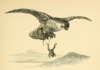
All the tellings of this tale conclude with the spectacle of the wrongdoer getting a brutal comeuppance. That seems wishful thinking to me, the action of a moral universe. But it does leave us with this macabre, memorable image of the frog and the mouse carried through the air in the claws of bird of prey (or a raven).
The Binding of Fate
If the tying-together seems like a contrivance, it can at least be justified when confronted by the danger of drowning in a river or pond. It is also an act which binds the fates of the two characters, and that on the surface is reassuring. But in Townsend’s version, the frog and mouse tie themselves together at the beginning, before they embark on their dinner dates. It becomes a gesture of friendship rather than security. And if the frog intends it as a device to kill his new friend, then he is more calculating and more treacherous the other villains.
A Love Story
The Townsend version hints at the romance of the tying-together. This symbolism is central to the text of the great Persian poet Rumi. The roles are reversed in Rumi’s account. His is a love story, and an allegory of body and soul, in which the mouse, frustrated it cannot be with the frog whenever it wishes, petitions its lover to allow themselves to be attached by a piece of string. Thus they may summon each other when the need arises. The frog consents, but the mouse is seized by a bird of prey and the frog is pulled from the pond—where it was immersed in eternal bliss—to its death. It should have resisted attachment, Rumi argues.
The symbolism of the tying-together fascinated me. The possibilities of the love story and its brutal conclusion seemed more intriguing than a tale of a wrongdoer getting his comeuppance. So I set out to investigate that emotional landscape in my own version of ‘The Frog and the Mouse‘.
Our shadows are incomplete, imperfect imitations of ourselves. When the sun is high, they cower unformed at our feet, while later, they walk by our side, like children, devoted and playful, and small. But as the sun goes down, the shadows start to outgrow us; they stretch, as far as they dare, before turning back and waving, forgetting they are still attached. And should we pass a wall, a fence, or a rock face, they rise up and tower above us, roles reversed, and we find ourselves the inferior party. Overshadowed, literally.
The Wolf and his Shadow
This sets the stage for Aesop’s fable ‘The Wolf and his Shadow’, in which a wolf impressed by the size of his shadow makes the error of over-estimating his powers.
ROAMING BY the mountainside at sundown, a Wolf saw his own shadow become greatly extended and magnified, and he said to himself, ‘Why should I, being of such an immense size and extending nearly an acre in length, be afraid of the Lion? Ought I not to be acknowledged as King of all the collected beasts?’ While he was indulging in these proud thoughts, a Lion fell upon him and killed him. He exclaimed with a too late repentance, ‘Wretched me! this overestimation of myself is the cause of my destruction.’
<Townsend>
The fable wastes no time getting to the point. In all extant versions, the wolf gets attacked the instant he concludes that his mighty shadow proves his pre-eminence among animals, as if the thought itself invites the attack. This strikes me as premature and abrupt. Unnecessarily so. Let the wolf enjoy his reveries as the sun goes down. It’s quite harmless to imagine oneself stronger than you really are. However, if the wolf were to act upon its delusions, that would be the point at which fantasy met reality, pride took a fall, and lessons would be learned.
Aesop made his think of deposing the Lion, the undisputed king of beasts. This falls into some rather conservative tropes affirming a natural hierarchy among animals, with the Lion at the apex, and casting the wolf as a deluded challenger, an upstart who needs to be destroyed or humiliated. The wolf is punished merely for thinking himself the superior.
Clinging to Former Glory
But what if the wolf wanted to retrieve its former glory, as leader of the pack. This is both more plausible – what would a lion be doing roaming the mountains? – and more substantial, because it suggests an emotional basis for the delusion: the persistence of self-image, a clinging to the past. It might also account for the creature’s isolation, roaming the mountains, or desert. And it would point to the richer theme of acceptance, or non-acceptance, of mortality.
The meaning does not change, but the accent shifts.
For me, the wolf’s error is not to forget his place in the scheme of things, but to fail to come to terms with the waning of his powers.
a downy birch with witches broom, nr Beeley, Derbyshire
When I first saw this tree, I stopped in my tracks. (I was running at the time so that’s not as hyperbolic as it sounds.) It has the same impact on me even now. The balls of witches’ broom seem like decorations. I see swirls of rich, inky colour where there is only muted green, silver, and auburn, as if a sepia filter had been layed over an illustration from a book of fairy tales. None of its neighbours have these adornments and usually broom would grow in thicker, less artful clumps. This tree seems favoured.
Many Aesopic fables are little more than a description of a situation or an action; to call them stories would be to stretch the definition. The situation does not develop, there is no turning point, sometimes there’s no conflict at all. A character makes an observation, a comment aimed at another and this all that is required to articulate the lesson. I love fable, but these are the fables I tend to pass over.
Yet if you stay a moment longer, peer at them up close, it’s possible to find something of value. (Or to put it another way, if you think about them, they’ll have given you something to think about!)
A HEAVY WAGON was being dragged along a country lane by a team of Oxen. The Axle-trees groaned and creaked terribly; whereupon the Oxen, turning round, thus addressed the wheels: ‘Hullo there! Why do you make so much noise? We bear all the labor, and we, not you, ought to cry out.’ Those who suffer most cry out the least.
It’s one of the more evocative of Aesop’s fables, conjuring images of mud and hedgerows and the dogged weariness of farm labour.
Two long-established versions (the Townsend and the Vernon Jones) are nearly identical and clearly derive from the same source (Babrius). Yet the epimythium—the last line stating the moral of the story—is different in each. Townsend points to the stoicism of the oxen; Jones denounces the complainant:
“Those who suffer most cry out the least” versus “They complain most who suffer least.”
Two sides of the same incident perhaps, but a significant shift of emphasis. I prefer Townsend. The stoicism in his version lends nobility to the oxen in their suffering, while there is something mean-spirited in dismissing the complaints of the cart.
And besides, you have to wonder if the axle might be grieving for the lost of the forest: cut down, branches lopped, worked and shaved, before being fashioned into the undercarriage of a cart. Who has greater cause to lament?
UP-DATE: I developed the idea of the axle’s lament into a new version of the fable here.
The Boy and the Filberts
‘The Boy and the Filberts’ appears in only some collections of Aesop. (It’s attributed to the stoic philosopher Epictetus.) Mundane and commonplace, and featuring human protagonists rather than an animal, it’s a fable I have disregarded until recently.
A BOY put his hand into a jar of filberts and grasped as many as his fist could possibly hold. But when he tried to pull it out again, he found he couldn’t do so, for the neck of the jar was too small to allow of the passage of so large a handful. Unwilling to lose his nuts but unable to withdraw his hand, he burst into tears.
A bystander, who saw where the trouble lay, said to him, “Come, my boy, don’t be so greedy. Be content with half the amount, and you’ll be able to get your hand out without difficulty.” Do not attempt too much at once.
Hard to argue with that advice, but wouldn’t all but the youngest child already have understood what needed to be done. It’s not unusual for the bystander to be replaced by a parental figure, the mother, in particular, making the fable more of a lesson for the nursery. As a result, if or when applied to adult situations, the tone becomes patronizing and loses its powers of persuasion.
The problem I think is that the action ends too soon. We are supposed to assume the boy merely wipes his eyes and follows the adult’s advice. It’s all too obvious and too easy. There should be a reaction to the bystander’s intervention. What if the boy does not like the solution offered? What if he already knows how to free his hand? Perhaps he is crying because he is frustrated with the state of the world, not because his hand is stuck in a jar. In that case, he decides to ignore the advice and comes up with another solution, albeit with its own problems.



 I observe this rule in my original fable about raindrops, ‘The Drops of Water‘. One of the few lessons I recall from my primary school days concerns the hydrologic cycle. It was known only as the ‘Water Cycle’ and really just explained where cloud and rain came from and where it ends up. Inspired by this elementary knowledge, I put the raindrops in the cycle and let them fall.
 Fables are simple narratives, often rendered in simple language, and as such easily dismissed as being ‘for children.’ Unfairly so. The Victorians may have put them to use in the nursery, but they were never intended for the younger reader.


 ‘
‘




 The Townsend version hints at the romance of the tying-together. This symbolism is central to the text of the great Persian poet Rumi. The roles are reversed in Rumi’s account. His is a love story, and an allegory of body and soul, in which the mouse, frustrated it cannot be with the frog whenever it wishes, petitions its lover to allow themselves to be attached by a piece of string. Thus they may summon each other when the need arises. The frog consents, but the mouse is seized by a bird of prey and the frog is pulled from the pond—where it was immersed in eternal bliss—to its death. It should have resisted attachment, Rumi argues.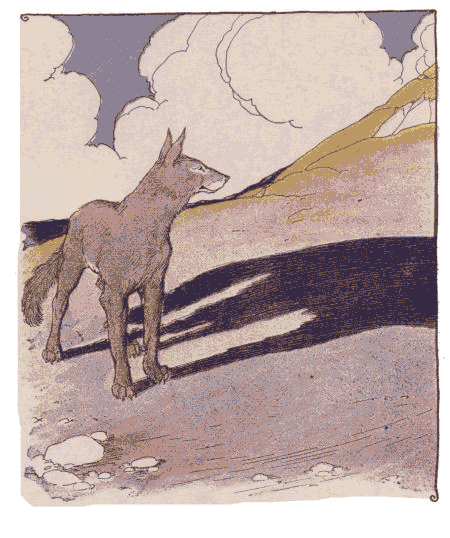
 Our shadows are incomplete, imperfect imitations of ourselves. When the sun is high, they cower unformed at our feet, while later, they walk by our side, like children, devoted and playful, and small. But as the sun goes down, the shadows start to outgrow us; they stretch, as far as they dare, before turning back and waving, forgetting they are still attached. And should we pass a wall, a fence, or a rock face, they rise up and tower above us, roles reversed, and we find ourselves the inferior party. Overshadowed, literally.
 The fable wastes no time getting to the point. In all extant versions, the wolf gets attacked the instant he concludes that his mighty shadow proves his pre-eminence among animals, as if the thought itself invites the attack. This strikes me as premature and abrupt. Unnecessarily so. Let the wolf enjoy his reveries as the sun goes down. It’s quite harmless to imagine oneself stronger than you really are. However, if the wolf were to act upon its delusions, that would be the point at which fantasy met reality, pride took a fall, and lessons would be learned.
 Many Aesopic fables are little more than a description of a situation or an action; to call them stories would be to stretch the definition. The situation does not develop, there is no turning point, sometimes there’s no conflict at all. A character makes an observation, a comment aimed at another and this all that is required to articulate the lesson. I love fable, but these are the fables I tend to pass over.