
Misadventures in the Land of Fables #68

“Ogni scarrafone è bell’ a mamma soja:”
~~~
This Neopolitan proverb, translated as ‘every cockroach is beautiful to its mother,’ sums up the fondness and natural bias a parent has for their children. Sometimes a proverb is all you need; narrative is redundant, little more than an amusing illustration of the point. There are fables that riff on this theme. They don’t amount to much in comparison.
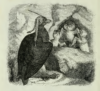
One involve crows, whose fledglings are alleged to be the ugliest in the avian world. When blessing each creature, God (Zeus) rejects the young of the crow and tells its mother to go and find a better looking example. The crow searches high and low but returns with the confession that she was unable to find any more beautiful than her own. “Quite right,” God replies. “Just so are all mothers; no other child is so beautiful in their eyes as their own.”
Another describes a beauty contest for animal offspring. Jupiter (Zeus) laughs when the monkey presents her snubbed-nosed cub, but the mother insists that to her this is the most beautiful of creatures. Ambrose Bierce, the American short-story writer (1842-1914), took this scenario further, giving the monkey a more robust response to the complacent deity, telling him to visit the museums and look at the sculptures of “fellows you begot yourself.” Jupiter realizes he would look fondly on those likenesses and awards the monkey’s cub the prize.
Jean de la Fontaine devises a brutal rendition. Fellow predators the eagle and owl agree not to attack each other’s young. The owl describes her own so fondly, with such superlative praise, that the eagle does not recognize them and ‘sups on them not slightly.’ I guess that’s what you call adding injury to insult.
You can find all the above here in University of Pittsburgh’s on-line library of folktales and folklore. (I could’ve just sent you there in the first place, but I wasn’t aware the catalogue included fables.)
Not listed is the one that inspired my investigations. ‘The Frog’s Beautiful Son’ authored by Odo of Cheriton/Sherinton (1180?-1247)—what a name! It’s not the most convincing tale for a number of reasons.
A frog has been nominated to attend the council of animals, but finding himself suddenly indisposed he sends his son in his stead. In haste, the son forgets his shoes. His father enlists a hare, being among the fastest of creatures, to convey the shoes to him. The hare asks how he should recognize the boy and to the frog’s exasperation attaches all the superlatives he uses to other animals, forcing him to make the vanity of this fondness explicit: “he looks like me.”
I imagined a minor twist that I thought would spin it in a different direction, but it didn’t really add that much and when it came to the writing I found I couldn’t get passed the infelicities of the story. Animals in folk tales hold civic meetings, I can accept that. I can accept the narrative convenience of the frog’s unexplained indisposition. But the shoes, the frog shoes, what are those? When do they wear shoes? And how could the boy travel without them? (It’s like an anxiety dream where you’re caught in public without your trousers—I suppose the entire fable operates at heightened level of anxiety.)
My contribution would have been only this: at the end the Frog wishes he had enlisted a slower creature who didn’t ask so many questions.
