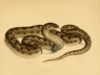
I was tempted to pretend this fable had ancient origins, something from south-east Asia, or the Panchatantra perhaps, where monkeys are in abundance. It doesn’t. But it might have done. I hesitate to dub it an original for that same reason. There are too many stories about the moon. Or maybe there are not enough.
This one is a simple tale of misplaced ambition. A monkey gets the idea the moon is close enough to touch and resolves to take it as a gift for his troupe.
I recall a children’s book in which a loving father climbed a ladder and brought the moon home to his son. I remember this story because my brother-in-law, an engineer, objected strongly to its affirmation of the pre-scientific point of view, and maybe to the high standard set for proofs of parental love. My objection would be directed it at the whimsicality of the metaphor but, aimed at children, I was inclined to give it a pass. It may have resurfaced twenty years later.
The immediate inspiration was a number of Japanese paintings of monkeys reaching for the moon. (The example included above could be an illustration of the last scene of the fable.) The images have a quaint, classical tranquility, but the association of the curious, audacious, tree-dwelling ape and the elusive, inconstant moon provoked my imagination.
Fables are full of implausible alliances between animals. One of the most incongruous is the friendship that develops between the monkey and the crocodile in the tale that opens Book IV of the Panchatantra. The incongruity is not played for laughs, unlike the tortoise who persuades two geese to carry him away. No, these two dudes just hang out and eat fruit.
A monkey lives in a rose-apple tree. One day, in a spirit of generosity, it throws one of the fruits to a passing crocodile. The croc likes it—it tastes like nectar—and the two become friends. That seems cool, though I have some trouble picturing them together. Does the monkey sit on the ground by the side of this deadly predator or does he descend only as far as the lowest branch?
No matter, the friendship doesn’t last.
The crocodile has a wife and he brings a rose-apple home for her. She likes it, too well. The rose-apple is no ordinary fruit. It’s a divine gift, and the crocodile’s wife seems to appreciate its value better than her husband. Reasoning that the heart of a creature whose diet is exclusively rose-apple must store a concentration of its ambrosial qualities, she demands her husband bring the monkey for—ahem, to dinner. She doesn’t have time to hang out and snack on fruit. Her husband agrees to her demand.
The rendition of this tale as quoted in Walton Ford’s ‘Panchatantra’ (originally published here: Folktales from India) ends at this point. A cute decision, because the last act is the reason I’d discounted the idea of revising the tale. The ending was too implausible. The crocodile husband too dumb. At the same time, concluding with his acquiescence to his wife’s demands places too great an emphasis on her jealousy and manipulation. I’ll be blunt. I could do without that element of the story.
Crocodiles tend to be monogamous, but they do not form domestic pairs with defined gender roles in which moms stay at home and covet rejuvenatory products, while hubby brings them dinner and gifts. All crocs fend for themselves, even their young are born ready for the hunt. So, enough of that shit. (Then again, a love triangle in which one of the partners declares their wish to eat the rival, that’s kind of interesting.)
No, the element that intrigued was the question of how to approach your spirituality. The generosity of the monkey in this respect—unusual in fables; the gentleness of the friendship and the pacification of the crocodile’s carnivorous nature, which is overthrown by the partner’s impatient cupidity (is that the word?). Ultimately, it was the crocodile’s sense of loss that captivated me. (The theme of Book IV is ‘Loss of gains.’)
It was here that I started and, after a few false trails, it was here that I ended up.
I first came across ‘How the Tiger Got its Stripes’ in Walton Ford’s Pancha Tantra. The story was recounted without a title (in English) so I didn’t know it was a ‘Just So’ story, an etiological narrative, and as Ford’s book is a collection of paintings inspired by fables, I was expecting a more didactic outcome and this may be why my train of thought followed a different track.
To summarise the story: the tiger’s stripes are burn marks sustained after it is tricked by a farmer. It asks a buffalo why it allows itself to be the servant of a man when it appears more powerful than its master. The answer is human intelligence. The tiger then enquires with the farmer about this intelligence and the farmer demonstrates it by persuading the tiger to allow itself to be tied up. He then sets a fire around the tiger. The tiger escapes, but not without sustaining these marks.
This is a delightful explanation because it uses not only intelligence but the ‘gift’ of fire, control of which is exclusive to humankind. It’s also a rather ironic account given the purpose of the tiger’s stripes is a deception itself, camouflage adapted to its colour-blind prey.
But as I suggested, I was more intrigued by the initial scenario.
THE PROMISE OF FREEDOM
A tiger watches a buffalo and a peasant plough a field. When the peasant breaks for lunch, the tiger approaches the buffalo to ask why it allows itself to be used in this way…
There are a number of fables in which an apex predator, typically a lion, teams up with other, lesser animals. An association which tends not to end well for the subordinates. I imagined events proceeding along those lines.
First, I saw the incident as one of recruitment and the tiger’s sidekick would be tasked with recruiting another member to the gang, sticking it to the man, then the idea of betrayal came up. You have to ask what use a buffalo would be to the tiger? And what service does the monkey provide?
Beyond the law, the strongest, or those most devoid of compassion, prevail. Promises of ‘liberty’ disguise a brutal vision of reality, organised around dominance and predation. A mockery performed by opportunists, grifters, and nihilist thugs.
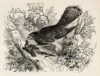
This fable was inspired by the painting by French-American ornithologist John James Audubon.
It started with a simple question. The kite has caught a snake: what was the snake doing when it was caught? The same as the kite, it was pursuing its next meal, a lizard, let’s say—why else would it be out and about? And what of the lizard? It too is motivated by hunger, busy on the skittish trail of a cricket. As for the cricket, I don’t know, but I think maybe it has a different goal, searching for a mate.
Unwittingly, the cricket leads a little dance of predation, the food chain laid out in the long grass. While the dizzy cricket may be oblivious, naive and optimistic, the snake imagines itself superior, in control, its place at the top of the order, stronger than the creatures it pursues, more deserving, therefore. It is in for a shock.
When the bird of prey attacks, the snake is taken by surprise; its view of the world is also assaulted. The imagined order is upset. “I am not your prey,” it protests. The weaker creatures are the ones who should be taken, it implies; they are the ones who must be the victims, as if the status of ‘predator’ afforded it some protection.
It’s a vain and questionable argument, but when did that stop us? We tend to consider ourselves more powerful and more deserving than in fact we are. From the bird’s eye view, we are no different to the other creatures who move across the land, whether we stroll, slither, scamper, or jump.
These illusions are torn apart by the swallow-tailed kite.
This Aesop fable (Perry 69) seemed relevant to social media and all the hot takes and concern trolling regarding recent political events. I thought I’d post the Townsend version unaltered, on Bluesky, but as I wrote some changes suggested themselves to me. For those of you who don’t have social media or who don’t yet follow me on Bluesky, here it is:
Writing is a journey of discovery, even re-writing or re-imagining or whatever it is I am doing in these misadventures, but the discovery is accidental and unpredictable. It only happens when things do not work out as planned. If your route proves unnavigable, if you take the wrong path, and you keep going, you may find yourself approaching your destination from an unexpected direction, or you may end up somewhere else entirely. It is this that reveals something about you, something you did not intend.
This week’s fable is an example. It is a revision of one of Aesop’s more obscure efforts (albeit one that is pegged near the top of the Perry list): ‘The Two Frogs By the Road‘
“TWO FROGS were neighbours. One inhabited a deep pond, far removed from public view; the other lived in a gully containing little water, and traversed by a country road. The Frog that lived in the pond warned his friend to change his residence and entreated him to come and live with him, saying that he would enjoy greater safety from danger and more abundant food. The other refused, saying that he felt it so very hard to leave a place to which he had become accustomed. A few days afterwards a heavy wagon passed through the gully and crushed him to death under its wheels. A willful man will have his way to his own hurt.”
As I read, I imagined someone more adventurous than attached, someone who rejected the comforts and compromises of community, a rugged individualist, a settler, and also someone who would ultimately rather prefer to impose their own limits on others in the name of freedom, their freedom.
So I set out to revise the tale as a satire of this rugged individualism, picking at the brutality inherent in that attitude. I may have achieved that, to an extent, but the finished work produces, I think, a pathos that was not originally intended, and a characterisation far more equivocal, of both pioneer and exile, the intrepid and the lost, and the self-destructive.
Hares are noted for their speed and for their timidity. Or, to put the two characteristics together: when they are startled from their hiding places, they are running for their lives, and that’s when we see them. I’ve seen plenty in my time, disturbing them as I womp through the middle of some bramble-encrusted woodland. Just a week ago I was running through a field of thistles when a hare detonated in front of me. It left its escape to the last moment, but gained a hundred yards up the hill before it turned to check whether I was in pursuit.
LOST IN THOUGHT
What, I wondered, had the hare been doing so inconspicuously among the dead thistles? Not grazing, or sleeping, resting perhaps, but would it really need to rest so often? Maybe it was simply lost in thought and my approach had shocked it out of its reverie. That might explain the burst of speed: a reflex, a survival mechanism, a sudden, automatic acceleration out of danger, triggered not consciously chosen.
This explanation also contradicts the arrogance attributed to the hare in Aesop’s classic fable, ‘The tortoise and the Hare.’
The hare’s speed might seem impressive to an on-looker, but to the hare itself it is nothing. The hare cares about its safety and its meditations, not its speed, which is no more than a means to an end. The fable now seems like a mistake. It is other creatures who boast of the hare’s speed, the tortoise who issues the challenge, and the bewildered hare is pressured into taking part. This became the starting point for my version of the tale.
‘SLOW BUT STEADY WINS THE RACE’—WHAT RACE?
I agree the tortoise has a point: determination and resolve will bring it to its destination while, despite its speed, the hare may never reach it, as it runs in whatever direction brings safety. However, their destinations are not the same so can their efforts be meaningfully compared?
It could instead be argued the hare is wasting its talents, as Laura Gibbs’ translation puts it: “the story shows that many people have good natural abilities which are ruined by idleness; on the other hand, sobriety, zeal and perseverance can prevail over indolence.”
Much as I approve the moral of the original fable, my version steps to one side to take a sideways glance at the idea of the race. It criticizes those who would make sport of others or who fail to appreciate the divergence in our goals and motivation. We are not all heading to the same destination.
Dmitry invited us to “go up to the next dog you see with a bone or food, and take it from him… Watch his reaction.” He was confident we would encounter hostility, which he construed as an assertion of ownership. I couldn’t really dispute that. I’ve been growled at dog with a bone between its teeth. Hell, we’ve probably all tried to take a toy away from a dog at some point; they tend not to want to let go. Whether this is evidence of ownership or not, I don’t know, but it could certainly be translated as the statement ‘mine, not yours,’ for that moment at least.
But what, I wondered, would happen if another bone were to be dropped nearby? Would the dog take any interest in it? Would it drop one for the other? Could it be tempted away from its possession and would it forget its ownership when it claimed the new item?
And what entitled it to either of the bones? Where did they come from? Who provided them?
These speculations started me along the road to the latest fable, in which two dogs contest first one bone, then another.
When I wrote this fable, I neglected to make notes on the process. A week later, I had forgotten how and why it had come about, where the idea originated or what I was thinking at the time. Fortunately, I had written about the episode in my journal.
It was a response to a discussion I witnessed on Twitter (aka X). The original post, more of an essay or screed, was entitled ‘Capitalism and the Way of the Dog’ and was written as a response to the claim that “property law” was a social construct and not “a natural mode of being.”
CONSIDER THE DOG
Consider the dog, wrote the author, Dmitry. “You can test this ‘property rights are innate’ claim very easily. Go up to the next dog you see with a bone or food, and take it from him… Watch his reaction.” Hostile, Dmitry asserted. In addition to the dog, Dmitry wanted us to consider the wasps and their nest, the lioness and its prey (a zebra), the crow and the shiny objects he collects. All intended as examples of the assertion of property rights in nature.
I felt I had to respond, for two reasons. One, because the argument didn’t seem quite right: it was reductive but, on the other hand, it was not without merit. An interesting combination. Moreover, it cut straight to the point where politics, philosophy, and economics collide. Also literature. Dmitry’s use of animal examples reminded me of the classical function of fable as elements of rhetoric.
I wanted to unpick his argument. Or complicate it. That’s how I tend to respond to reductive claims. And I am particularly uneasy about claims concerning what is natural or not. These claims always strike me as normative and exclusionary. What is the attraction, I wonder? Is it because to be natural is self-evidently right and unnatural wrong?
So I did as Dmitry suggested. I considered the dog. I considered the wasp. And I considered ‘the lioness and the zebra she had captured.’ This is what I concluded about the latter.
THE LIONESS AND THE ZEBRA
The lioness eats the zebra. That’s why she hunted it down and killed it. You might say for a brief period, from the killing to the end of the meal, the lioness considers the zebra’s carcass as its property. Any attempt to take it away from her would be deterred with violence or the threat of violence. This would seem a fairly uncontroversial observation.
But why stop there? Doesn’t there come a point when the lioness moves on, having eaten her fill, a point where the scavengers take over? Hyenas, vultures, also rodents and insects consume the remainder of the carcass. The lioness doesn’t take more than she things she needs. She doesn’t assert property rights over the excess. And she doesn’t hoard.
But what if she were to hoard? How would that look? Would it be considered equally natural? This is the question I asked, and I recalled the lions encountered here in the land of fables: the lion who terrorized the forest with its rampaging, ‘The Lion and the Hares‘; the lion that bullied its partners into giving up their share—there’s a few of those: ‘The Lion’s Share‘ ‘The Wolf, the Fox, and the Lion‘.