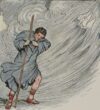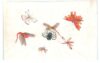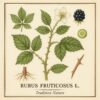
When I write a new version of an old fable I can usually find a vintage illustration or three to add some visual appeal to my commentary. For an original, it’s not so easy. I can source an image of the animal protagonist—there’s a tradition of highly aesthetic, scientific illustration to draw upon—or I could draw it myself.
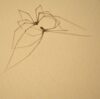
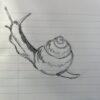
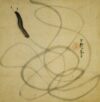
My first attempt at illustration (see below) tried to capture the size difference between snail shell and dung beetle that was a key element of the story, at least when I began to write. But the image didn’t work thematically. It adopts the beetles point of view and portrays it in an almost heroic confrontation with a force greater than itself, a mystery.
More appropriate would be the snail’s departure, but even that is only part of the story. The beetle needs to be there, reacting to this turn of events. Perhaps one day I’ll add him to the picture.
Drawing is one thing, illustration another: both are hard.
James Thurber’s second volume of modern fables offers more of the same whimsical, witty, and remarkably wide-ranging short narratives. Entertaining, but for those who like their fables to strike a more serious tone the collection is disappointing.
Nothing sticks, nothing much.
I was amused to see a version of Aesop’s ‘The Fox and the Crow’ in which the crow offers to share the cheese with the trickster, as it does in my re-working. (More Fables.) Here it serves as an inducement for the fox to stay and listen to the crow’s self-praise. The moral: “No one else can praise thee quite so well as thou”
Thurber adopts an archaic style for his epimythiums (the moral at the end). This is amusing; at the same time betrays a lack of confidence in the form. In the modern age, you can’t pretend to wisdom without adopting a tone either of world-weariness or of trivialising parody. If you make them laugh, you avoid being laughed at.
The fables closest to my taste were ‘The Lion and the Lizard’, whose tragic conclusion achieves a sort of melancholy grace, the glutton eats himself to death while the creature he had once terrorised starves, and the tale of ‘The Peacelike Mongoose’ ostracised, indeed, exiled for his rejection of violence.
“I am trying to use reason and intelligence,” said the strange new mongoose. “Reason is six-sevenths of treason,” said one of his neighbours. “Intelligence is what the enemy uses,” said another.
Thurber’s trenchant response to the McCarthyite ‘Red Scare’ in the 1950s America. And you might say the miscommunication at the heart of ‘The Weaver and the Worm’ speaks as much to the current age of ‘bullshit’ and ‘bad faith’ as it does to the paranoia and persecution of the Fifties.
“We live, man and worm, in a time when almost everything can mean almost anything, for this is the age of gobbledy-gook, doubletalk, and gudda.”
A few weeks ago I picked up a two volume collection of works by James Thurber, ‘Vintage Thurber.’ Among these works were the ‘Fables For Our Times.’ These were very nice. Fantastic, in the superlative if not the ‘wildly imaginative’ sense of the word. Where Ambrose Bierce is cynical and disenchanted, Thurber is tuned to human foibles with a wry sense of humour and a delightful turn of phrase.
There are some witty riffs on the classics: the versions of ‘The Country Mouse and the City Mouse,’ ‘The Tortoise and the Hare,’ and ‘Little Red Riding Hood’ are flippant, but ‘The Sheep in Wolf’s Clothing’ is a reversal with a point. The originals are better and these make up most of the collection. I’ll do no more than cite a few of my favourites.
‘The Very Proper Gander’ is a tale of pernicious Chinese whispers, which charts the path to social exclusion through the misapprehension of ‘proper gander’ as ‘propaganda’ and so on. A fable almost for our social media times.
‘The Lion Who Wanted to Zoom’—no, not that kind of ‘zoom’—displays the raw brutality of Aesop in its critique of ill-advised ambition.
‘The Birds and the Foxes’ is very very droll. You hardly notice just how dark it is. For obvious reasons the foxes object to the high fence erected to create a sanctuary for Baltimore orioles and when dismantling it they argue they are only setting them free.
‘The Moth and the Star’ is perhaps the one most aligned to the ‘head in the clouds’ characters of ‘a boy in a park.’ A young moth sets his heart on a star and clings tenaciously to that goal despite his parents’ more realistic recommendations of bridge lamps and street lamps. In so doing, and never reaching his goal, he never gets scorched and outlives everyone.
The title ‘Fantastic Fables’ is as misleading as the cover image. These are not ‘fantastic’ or ‘fantastical.’ You might call them whimsical if they weren’t so deeply misanthropic and if the characters weren’t figures of contemporary life, familiar objects of satire (politicians, clergy, doctors, judges). These are the caustic amusements of a world-weary journalist too acquainted with the bad side of probably just about everyone.
They are fables, to the extent that they adopt the fable form, a short simple narrative or dialogue with a resolution that produces or points to a message. But they feel more satirical than didactic: the message boiling down to ‘don’t be fooled, kid’ or ‘they’re all the same’ and the effect, despite the agile wit, so dispiriting—literally demoralizing—that there’s little else to do but reach for the bourbon like the most stereotypical hard-bitten newspaperman.
The last third of the collection, the Aesopus Emandatus, features riffs on Aesopic originals. Bierce doesn’t do much of note with them. For example, with ‘The Tortoise and the Hare’ the twist is the tortoise doesn’t realise the hare had in fact won the race and only fell asleep when returning to cheer on his rival. Meanwhile, when the dog attacks its own reflection, mistaking it for another, he pulls from the pond a piece of meat discarded by a butcher’s boy. Bierce is witty and sharp, but his disillusionment reflexively trivialises anything pretending to wisdom.
But there are few good entries, two of these are originals:
The Man and the Eagle
“An Eagle was once captured by a Man, who clipped his wings and put him in the poultry yard, along with the chickens. The Eagle was much depressed in spirits by the change.
“Why should you not rather rejoice?” said the Man. “You were only an ordinary fellow as an eagle; but as an old rooster you are a fowl of incomparable distinction.”
A Needless Labour
“After waiting many a weary day to revenge himself upon a Lion for some unconsidered manifestation of contempt, a Skunk finally saw him coming, and posting himself in the path ahead uttered the inaudible discord of his race. Observing that the Lion gave no attention to the matter, the Skunk, keeping carefully out of reach, said:
“Sir, I beg leave to point out that I have set on foot an implacable odour.”
“My dear fellow,” the Lion replied, “you have taken a needless trouble; I already knew that you were a Skunk.”
And the other is snappy revision of ‘The Ant and the Grasshopper,’ in which the fact that, for all their industry, the ant is not a producer but a gatherer and an opportunist is turned against their smug claims of prudence and merit.
The Grasshopper and the Ant
“One day in winter a hungry Grasshopper applied to an Ant for some of the food they had stored.
“Why,” said the Ant, “did you not store up some food for yourself, instead of singing all the time?”
“So I did,” said the Grasshopper; “so I did; but you fellows broke in and carried it all away.”
‘Fantastic Fables‘ was published in 1899 and is out of copyright. You can read or download the complete volume at Archive.org and Project Gutenberg.
“You are like the man who lay down to give his shadow a rest.”
~~~
This proverb in the second person feels like the application of a fable: ‘you’ are being criticised by way of comparison to a fable. But there is no such fable, nor indeed is there a ‘you’ because the object of the criticism is yet to be found. The proverb is armed and ready, if you can find occasion.
What does it mean? Don’t ask me I merely wrote it. [Answers, please, in the comments.]
It seems I am fascinated by shadows, particularly those that accompany us, attached but uninvited, as we walk the streets. At times, on a bright summer day, our shadows are doubles, following us, preceding us, slipping alongside, getting under our feet. Other shadows swallow them. They vanish into ginnels and alleyways, dissolve in the leafless gaps of hedgerows. Who knows what else they get up to? A photographer will tell you they disfigure portraits and must be managed, redirected, softened.
The man who lay down to give his shadow a rest was making an excuse for his own wish to relax. He projects it onto his shadow, which is itself a kind of spontaneous projection, as the shadow felt the exertion of his body’s movements and would at some point be fatigued by all the contortions it must perform. It’s foolish, dare I say, whimsical. But really it’s an example of someone making an excuse, pretending a generous motive for an act which gratifies them.
BACK TO BABYLON
The form of this aphorism was inspired by the fragments of Sumerian proverbs I discovered last week. A number of these were rendered in the second person:
“Like the ox, you do not know how to turn back.”
“Like the wild bull, you only do what pleases you.”
“You go like an elephant to raise a sunken boat.”
Many of these proverbs are rooted in the imagery of agriculture—oxen, donkeys, ploughs—which was no surprise coming from the rich arable lands between the Tigris and the Euphrates (aka Eden). What struck me, and I confess amused and delighted me, was the promince of scatalogical motifs. (See the boastful, defecating elephant of the fable.) Thinking about it now, it should not have been so unexpected. Farmland is full of manure, dung, and the fable was not high-brow literature, the literature of the poets, metaphysics and myths; indeed, not so much literature, as collected oral sayings and stories.
The meaning of some is obscure, others intriguing, while many reveal the consistency of folk wisdom through the ages; some things just don’t change.
“The wild bull is taboo for the plough.” “No one walks for a second time in the place where a lion has eaten a man.” “If the lion heats the soup, who would say “it is not good?” “Imagine a wolf is eating. Utu looks down on it and says: “When will you praise me?” “When I’m fat!” would be the answer.
and my personal favourite:
“The dog gnawing on a bone says to his anus: “This is going to hurt you.”
I read somewhere that among the earliest extant fables was one entitled ‘The Elephant and the Wren.’ I was intrigued. The elephant is a stalwart of Middle-Eastern folk literature, but the wren? What was it up to four thousand years ago, I wondered? What did wrens mean to the Ancients. I went a-looking and found a pdf of proverbs, or fragments of proverbs, translated from cuniform tablets dating back to at least 1500 BCE, from either the Akkadian or Sumerian, I’m not sure. I think that’s all there is,.
‘The Elephant and The Wren‘ appears in two versions, a short dialogue, no more than an exchange of words.
“The elephant spoke to himself: “There is nothing like me among all the creatures of Cakkan!” The wren answered him: “But I, in my own small way, was created just as you were!” The elephant spoke to himself: “Among all the creatures of Cakkan, the one that can defecate like me has yet to be created!” The wren answered him: “But I, in my own small way, can defecate just as much as you!”
I laughed out loud at the talent the elephant chose to boast about. Really? Are the dung production abilities of elephants so renowned? I mean, yes, I’m not going to argue. And yet, is that what makes you special? Is that the best you can do? Is that it? It could be the work is incomplete. My guess is these are two versions of the same fable, the second being an earthier variation, so to speak. As presented, I read them as a progession, with the elephant responding to the wren’s challenge, and this for me pointed to a missing third beat in the narrative. A conclusion. This got me thinking.
Much as I am fond of elephants, the boastfulness of this one, and the pride it took in its own shit, reminded me of a certain political figure whose relationship with truth is one of contempt. Perhaps I should have changed the animal from elephant to bull. Later iterations of this theme, of large beast encountering smaller creature, do make that change to a bull, or a camel (!), while the creature becomes something smaller and less charming, an insect, a gnat, a flea or a mosquito. Thus the fable makes it way from Babylon to Ancient Greece, and through to us, via Babrius. (You can read a number of versions here)
“A gnat settled on the horn of a Bull, and sat there a long time. Just as he was about to fly off, he made a buzzing noise, and inquired of the Bull if he would like him to go. The Bull replied, ‘I did not know you had come, and I shall not miss you when you go away.’ Some men are of more consequence in their own eyes than in the eyes of their neighbors.”
Curious that the later fables grant the big beast its elevated status and the little one becomes an impertinence, the so-called impertient insect.
Ha, what a phrase! Dated, sure, but I think I’m going to adopt it as a response to, well, grievous extractions, or in other words, tedious demands on my time. A kind of dismissive verbal sigh: “ah, the intolerable grievousness of extractions again.”
The phrase is the caption to the image above, an etching by … which appears in the published version of Arthur Golding’s ‘A Moral Fabletalk,’ taken from the original source and not from Golding’s manuscript. The source was a hybrid collection of fables and emblems. What do I mean by ‘emblem’? I’ll let Golding’s editors explain:
“Emblems were an art form that combined visual and verbal media, and typically consisted of at least three parts: a short motto or phrase, an image, and a slightly longer poem or inscription.”
(Liza Blake and Kathryn Vomero Santos)
I’m not entirely clear whether the emblem was the illustration of a lesson or if the lesson was found in the image. I suspect it must be the latter. This accounts for why a number of the entries found in Golding and his sources seem to go nowhere. They don’t dramatise the argument. They explain it. They pull the thread out of the image and discourse upon it. It’s not as charming or as persuasive as the little scenes we find in fables. It’s commentary more than storytelling.
BAD BOSSES, BULLIES, AND LIARS
But here the image is quite potent. A grim-faced merchant or peasant wields the stick to a horse up to its knees (carpus) in mud and struggling with a heavily-loaded cart. The “extractions” are the horse’s labours and the pain required appears grievous. The elaboration in Freitag/Golding’s text piles on the pain and ends with the vicious driver giving the horse two options, haul itself out of the mire or die under his hand. What the lesson is, I’m not sure?
A biblical citation, often no better than tangential to the preceding narrative, accompanies the emblems. Here it repeats the malice of the Pharoah towards the immigrant Israelites, demanding they make their quota of bricks without their supply of raw materials. Perhaps then the lesson is that we will suffer abuse. We can only forbear and, with providence, make our way to the Promised Land. Something like that?
I’m not keen on forbearance. My elaboration, ‘The Merchant and the Mire,’ which you can read here, is more political, more a denunciation of abuse and tactics of exploitation. Among the things are like least in this world are bad bosses, bullies, and liars. Don’t listen to them.
I can’t find the exact image that inspired the latest fable, ‘The Frog and the Moon,’ but in my search I discovered the sub-genre of ‘frogs making music by moonlight’ and I hate it. Regardless of tasteful composition and colour palette, as seen above, the idea is whimsical and the result pure kitsch. The genre was popular in the Victorian era and probably has its origin in the frog-obsessed work of late C18th Japanese artist, Matsumoto Hoji—he of the ‘sad’ frog illustration. If Hoji came up with this banjo affair, he was scraping the barrel.
What then could have inspired me?
Glad you asked. It was the moon. The creature’s relationship with the moon. The banjo/guitar signified music-making. Music and the moon. That is what I saw, that was the starting point. Frogs don’t play instruments, but they do vocalize at night—they can make a hell of a racket. So I kept the music, but dropped the banjo early on. Does this change overcome the whimsicality of the image? (It helped, I think, that the image I saw was pen and ink, the kitsch was tempered by the absence of colour.)
I’ve been told that the stories in the ‘a boy in a park‘ collection are whimsical, so too the Wasp Tales. They depict fanciful events, things that can’t happen, they are fantasies. That is one part of it, the lack of realism, the departure from reality. And perhaps this accounts for the mixed reaction because there is an expectation that such things must delight and amuse rather than investigate and explore: they should be light not heavy, provide escape and not rub your face in it—the boy in the park is nothing if not abject, vulnerable and up to his elbows in dirt.
As you can see, I am ambivalent about whimsicality. For me, the whimsical has no depth or savour. It tickles the tongue and then it’s gone. It is something to be enjoyed in the moment, passing the time, goofing around. On the other hand, the lack of realism allows for concentration on the shaping of the idea; free of the weight of resemblance, the idea emerges, rises, and condenses again as metaphor. The lightness of fables is not frivolity but agility and all of my work is fable: the current project, the Misadventures in the Land of Fables, obviously, but also every story in ‘the park’ and every adventure of the Angry Wasp. Their intent is the development of an idea, a lesson, even if that a lesson folded around itself and pulled into a knot for the reader to unpick.
Whimsicality with a purpose, if you like, if that is possible.
This Neopolitan proverb, translated as ‘every cockroach is beautiful to its mother,’ sums up the fondness and natural bias a parent has for their children. Sometimes a proverb is all you need; narrative is redundant, little more than an amusing illustration of the point. There are fables that riff on this theme. They don’t amount to much in comparison.
One involve crows, whose fledglings are alleged to be the ugliest in the avian world. When blessing each creature, God (Zeus) rejects the young of the crow and tells its mother to go and find a better looking example. The crow searches high and low but returns with the confession that she was unable to find any more beautiful than her own. “Quite right,” God replies. “Just so are all mothers; no other child is so beautiful in their eyes as their own.”
Another describes a beauty contest for animal offspring. Jupiter (Zeus) laughs when the monkey presents her snubbed-nosed cub, but the mother insists that to her this is the most beautiful of creatures. Ambrose Bierce, the American short-story writer (1842-1914), took this scenario further, giving the monkey a more robust response to the complacent deity, telling him to visit the museums and look at the sculptures of “fellows you begot yourself.” Jupiter realizes he would look fondly on those likenesses and awards the monkey’s cub the prize.
Jean de la Fontaine devises a brutal rendition. Fellow predators the eagle and owl agree not to attack each other’s young. The owl describes her own so fondly, with such superlative praise, that the eagle does not recognize them and ‘sups on them not slightly.’ I guess that’s what you call adding injury to insult.
You can find all the above here in University of Pittsburgh’s on-line library of folktales and folklore. (I could’ve just sent you there in the first place, but I wasn’t aware the catalogue included fables.)
Not listed is the one that inspired my investigations. ‘The Frog’s Beautiful Son’ authored by Odo of Cheriton/Sherinton (1180?-1247)—what a name! It’s not the most convincing tale for a number of reasons.
A frog has been nominated to attend the council of animals, but finding himself suddenly indisposed he sends his son in his stead. In haste, the son forgets his shoes. His father enlists a hare, being among the fastest of creatures, to convey the shoes to him. The hare asks how he should recognize the boy and to the frog’s exasperation attaches all the superlatives he uses to other animals, forcing him to make the vanity of this fondness explicit: “he looks like me.”
I imagined a minor twist that I thought would spin it in a different direction, but it didn’t really add that much and when it came to the writing I found I couldn’t get passed the infelicities of the story. Animals in folk tales hold civic meetings, I can accept that. I can accept the narrative convenience of the frog’s unexplained indisposition. But the shoes, the frog shoes, what are those? When do they wear shoes? And how could the boy travel without them? (It’s like an anxiety dream where you’re caught in public without your trousers—I suppose the entire fable operates at heightened level of anxiety.)
My contribution would have been only this: at the end the Frog wishes he had enlisted a slower creature who didn’t ask so many questions.